
Introduction
Social media has become an important marketing channel for small businesses looking to increase brand awareness, connect with customers, and generate sales. Whether you run a local shop in Manchester, a service-based business in London, a startup in New York, or an online store in Los Angeles, the right social media strategy can help you reach your target audience and grow your business.
However, successful social media marketing involves more than publishing regular posts. Businesses need to choose the right platforms, create useful content, engage with their audience, and use paid advertising strategically.
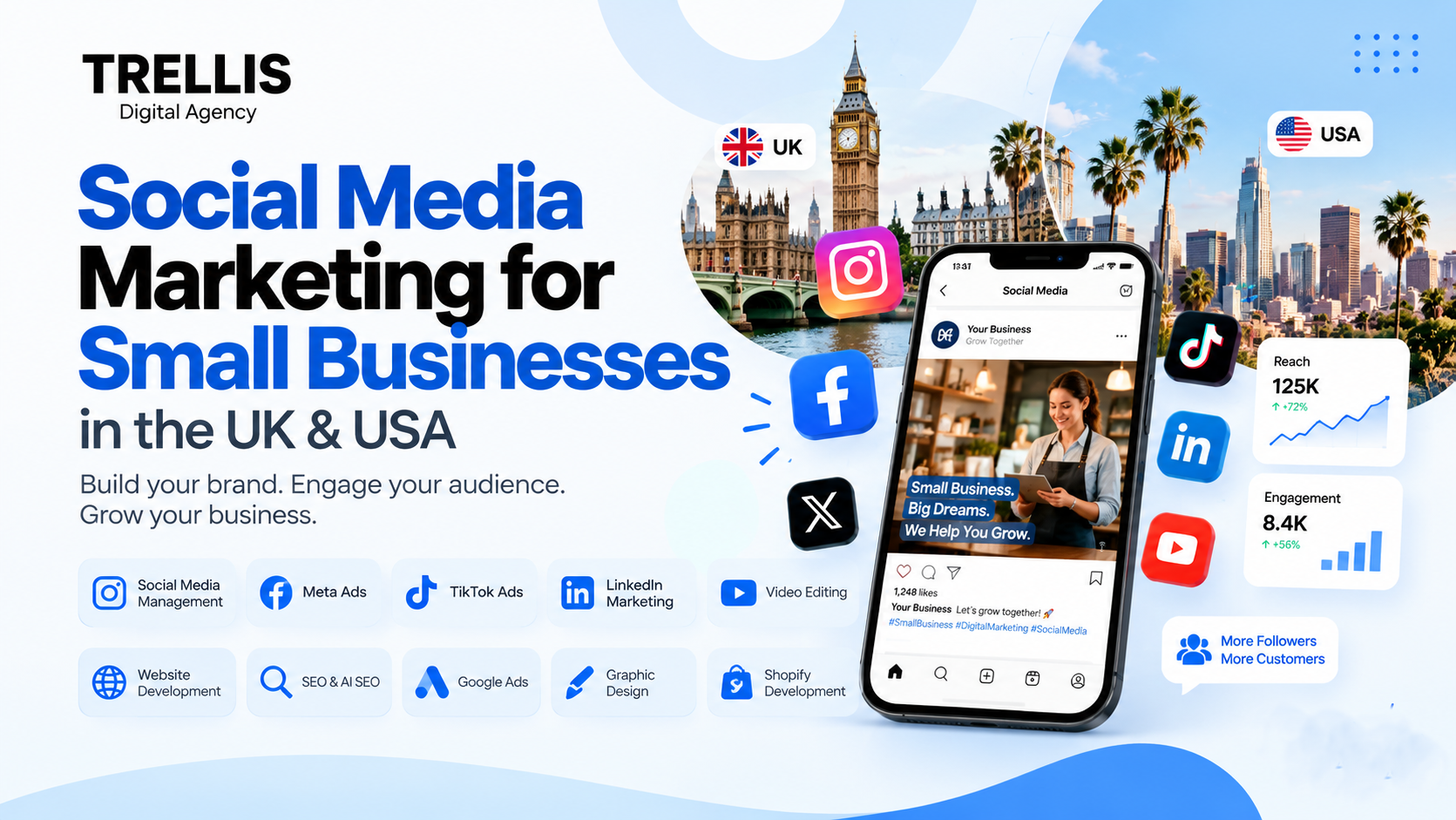
At Trellis Digital Agency, we help businesses develop practical digital marketing strategies designed around their goals, audiences, and budgets. In this guide, we explore effective social media marketing strategies for small businesses in the UK and USA.
Why Is Social Media Marketing Important for Small Businesses?
Social media gives small businesses opportunities to connect directly with potential customers without relying entirely on traditional advertising. With a clear strategy, businesses can build recognition, establish credibility, and encourage customers to take action.
Here are some key benefits of social media marketing:
- ·
Increased brand awareness: Introduce your business, products, and services to relevant audiences.
- ·
Direct customer engagement: Answer questions, respond to comments, and build relationships with potential buyers.
- ·
Website traffic: Share useful content and direct interested users to your website or product pages.
- ·
Lead generation: Encourage enquiries, bookings, consultations, and other valuable actions.
- ·
Customer loyalty: Keep existing customers informed about offers, updates, and new products.
- ·
Measurable performance: Track reach, engagement, clicks, leads, and conversions to understand what works.
For small businesses competing in busy markets such as London, Birmingham, Manchester, New York, Chicago, and Los Angeles, a focused social media strategy can help them communicate their value and stand out from competitors.
1. Set Clear Social Media Marketing Goals
Before creating content, decide what you want your social media activity to achieve. Without clear goals, it can be difficult to measure performance or determine whether your marketing efforts are worthwhile.
Common social media marketing goals include:
Brand Awareness
If your business is new or entering a competitive market, focus on introducing your brand to the right audience. Share educational posts, behind-the-scenes content, product demonstrations, and useful information about your services.
Website Traffic
If you want people to visit your website, publish content that gives them a reason to click. This could include blog articles, product guides, service explanations, or special offers.
Leads and Enquiries
Service-based businesses can use social media to encourage consultation requests, quote enquiries, appointment bookings, and direct messages.
Sales and Conversions
E-commerce businesses can promote products, explain their benefits, share customer feedback with permission, and direct users to relevant product pages.
Choose a small number of measurable goals and review your progress regularly. For example, a business may aim to increase qualified enquiries, improve website visits from social media, or generate more online purchases.
2. Choose the Right Social Media Platforms
One of the most important social media marketing strategies for small businesses is selecting platforms that match their audience and business objectives. You do not need to maintain an active presence on every social network.
Facebook can help local businesses, retailers, service providers, and community-focused brands share updates, promote offers, communicate with customers, and run targeted advertising campaigns.
It can be useful for businesses serving specific locations across the UK and USA, particularly when local awareness and direct customer communication are important.
Instagram is suited to businesses that can communicate through photographs, short videos, Stories, and Reels. Fashion brands, restaurants, beauty businesses, fitness providers, retailers, and lifestyle brands can use it to showcase products and experiences.
TikTok
TikTok can help businesses reach audiences through short, engaging videos. Product demonstrations, practical tips, tutorials, behind-the-scenes clips, and entertaining educational content can help introduce a brand to new viewers.
Results depend on the relevance and quality of the content, audience interest, and consistency rather than simply posting frequently.
LinkedIn is particularly useful for B2B companies, consultants, professional service providers, recruitment businesses, and agencies. Businesses can share industry insights, demonstrate expertise, build professional relationships, and generate relevant business enquiries.
YouTube
YouTube can support businesses that benefit from longer educational content, product demonstrations, tutorials, customer guidance, and detailed explanations of services. Short-form video can also help businesses reach viewers who prefer quick information.
How to choose: Start with one or two platforms where your target customers are active. Develop a consistent content plan, review performance, and expand to other platforms when you have the resources to manage them effectively.
3. Create a Practical Social Media Content Plan
Consistency is important, but posting content without a clear purpose can waste time and resources. A content plan helps small businesses organise their ideas, maintain a regular presence, and communicate a clear message.
A useful approach is to divide content into several categories.
Educational Content
Share tips, answers to frequently asked questions, industry insights, and simple guides. Educational content can demonstrate your knowledge and help potential customers understand their problems and possible solutions.
Product and Service Content
Explain what your business offers, who it serves, and how customers can get started. Use clear descriptions, demonstrations, photographs, and videos to make your offering easier to understand.
Behind-the-Scenes Content
Show aspects of your business that help customers understand your process. This could include preparing an order, introducing team members, explaining how a service works, or showing how a product is made.
Customer-Focused Content
With appropriate permission, share customer feedback, reviews, testimonials, or examples of completed work. Authentic customer experiences can help build trust, provided the content is accurate and not misleading.
Promotional Content
Promote discounts, seasonal campaigns, new services, product launches, and special events. Keep promotional posts clear about the offer, its conditions, and the next step customers should take.
A balanced content plan should provide value while also making it easy for interested customers to discover your products or services.
4. Use a Weekly Social Media Content Calendar
A content calendar makes social media management easier, particularly for small businesses with limited time. It allows you to plan posts in advance, coordinate campaigns, and avoid last-minute content creation.
Here is an example of a simple weekly schedule:
Day
Content idea
Main objective
Monday
Educational tip or industry insight
Build awareness
Tuesday
Product or service feature
Explain your offering
Wednesday
Short video or Reel
Reach new audiences
Thursday
Customer question or helpful guide
Encourage engagement
Friday
Offer, promotion, or call to action
Generate enquiries or sales
Weekend
Behind-the-scenes or community content
Strengthen relationships
This is a sample schedule, not a fixed rule. Your ideal publishing frequency depends on your audience, available resources, platform, and content quality.
Review your analytics to identify when your audience is most active and which types of posts generate meaningful engagement. Scheduling tools can also help you prepare content in advance and maintain a consistent publishing routine.
5. Focus on Engagement, Not Just Followers
A large follower count does not automatically translate into sales or business growth. Relevant engagement can provide more useful insight into whether your content connects with the right audience.
To encourage meaningful engagement:
- ·
Respond to relevant comments and direct messages.
- ·
Answer common questions clearly and professionally.
- ·
Ask useful questions that invite genuine responses.
- ·
Use polls and interactive features where appropriate.
- ·
Participate in relevant industry discussions.
- ·
Acknowledge customer feedback and address concerns respectfully.
- ·
Provide a clear next step when users express interest in your products or services.
For example, a business offering services in Leeds might publish a guide that answers a common customer question. A company targeting customers in Miami might create a short demonstration showing how its product works. In both cases, useful content gives people a reason to interact with the brand.
Engagement should support your wider business goals. Track meaningful actions such as enquiries, website visits, bookings, and purchases alongside likes and comments.
6. Use Short-Form Video to Explain Your Business
Short-form video is an effective format for demonstrating products, explaining services, sharing tips, and introducing the people behind a business.
Small businesses do not always need expensive production equipment. A smartphone, good lighting, clear audio, and a useful idea can provide a practical starting point.
Consider these video ideas:
- ·
A quick introduction to your business.
- ·
Three common mistakes customers should avoid.
- ·
A demonstration of how a product works.
- ·
Answers to frequently asked questions.
- ·
A behind-the-scenes look at your working process.
- ·
A short explanation of a service and its benefits.
- ·
A step-by-step tutorial related to your industry.
Make the opening seconds relevant to the viewer, keep the message focused, and add captions where appropriate. Ensure that any claims about products or services are accurate.
Adapt videos to the platform and audience rather than uploading identical content everywhere without considering format, context, or user expectations.
7. Invest in Paid Social Media Advertising
Organic content helps businesses build a presence over time, while paid social media advertising can provide additional opportunities to reach selected audiences. Platforms such as Facebook, Instagram, LinkedIn, and TikTok offer different advertising options depending on the campaign objective and account eligibility.
Small businesses can use paid campaigns to:
- ·
Increase awareness of a new brand or service.
- ·
Drive relevant traffic to a website.
- ·
Generate leads and enquiries.
- ·
Promote products or special offers.
- ·
Encourage online purchases.
- ·
Reach eligible audiences who have previously interacted with the business.
Start With a Clear Advertising Objective
Choose a campaign objective that reflects the result you want. A campaign designed for website traffic may not produce the same results as one optimised for qualified leads or purchases.
Define Your Target Audience
Consider location, relevant interests, customer needs, and other targeting options available on the platform. A business serving Manchester customers may need a different campaign from a company selling products throughout the United States.
Test Your Creative
Experiment with different images, videos, messages, headlines, and calls to action. Change variables methodically so you can better understand what influences performance.
Monitor Results
Track spending, clicks, leads, purchases, and conversion costs where measurement is available. Avoid judging a campaign solely by impressions or likes when the main objective is generating sales.
Start With a Manageable Budget
Set a budget that your business can afford to test and evaluate. Review results before increasing spending, and make changes based on reliable performance data rather than assumptions.
Paid advertising works best when supported by a clear offer, relevant creative, a suitable landing page, and a process for following up with enquiries.
8. Use Local Social Media Marketing to Reach Nearby Customers
For businesses serving particular areas, local relevance can make social media content more useful. Customers may want to understand where a service is available, which locations are covered, or how to contact the business.
Businesses targeting UK markets such as Manchester, Leeds, Liverpool, Birmingham, Bristol, Glasgow, and Edinburgh can create content around relevant services, local events, customer questions, and regional needs.
Similarly, businesses targeting US markets such as New York, Los Angeles, Chicago, Houston, Miami, San Francisco, and Dallas can adapt their messaging to the locations and audiences they serve.
Effective local social media practices include:
- ·
Clearly stating the areas your business serves.
- ·
Sharing relevant local updates when appropriate.
- ·
Answering location-specific customer questions.
- ·
Using location tags or local hashtags where relevant.
- ·
Promoting events, offers, or services available in the target area.
- ·
Keeping contact details and business information accurate.
Only mention locations you genuinely serve or are intentionally targeting. Do not imply that your business has a physical office, shop, or local team in a city if it does not.
For businesses that depend on local enquiries, social media can complement a broader strategy involving local SEO, an optimised website, and an accurate business profile.
9. Optimise Your Social Media Profiles
Your profile is often one of the first places potential customers visit after discovering your content. A clear and complete profile helps people understand your business and decide what to do next.
Check that your profile includes:
- ·
A recognisable logo or suitable profile image.
- ·
A clear description of your business.
- ·
Relevant products, services, or specialities.
- ·
Accurate contact information.
- ·
A website link or appropriate landing page.
- ·
Current business hours or service information where relevant.
- ·
A clear call to action.
Use consistent branding across your platforms so that customers can recognise your business easily. Keep pinned posts, highlights, and profile links up to date.
If you use social media to generate leads, make sure someone is responsible for responding to enquiries. A well-optimised profile is less effective when potential customers cannot get timely, helpful answers.
10. Measure Social Media Performance and Improve Your Strategy
Social media analytics help businesses identify what is working and where adjustments may be needed. The most useful metrics depend on your objectives.
Metric
What it helps you understand
Reach
How many unique accounts saw your content
Impressions
How often content was displayed
Engagement rate
How audiences interacted with content relative to the chosen measurement
Link clicks
How many users clicked a link
Leads
How many enquiries or prospects were generated
Conversions
How many users completed a desired action
Cost per lead
How much advertising spend was used per lead
Return on ad spend (ROAS)
Revenue attributed to advertising relative to advertising spend, where reliable tracking is available
Review your results regularly rather than changing your entire strategy after one post or campaign. Identify patterns across different content types, audiences, and campaign periods.
For example, if educational videos consistently attract relevant visitors but few enquiries, review the call to action, website experience, and relevance of the offer. If paid campaigns generate many low-quality leads, revisit audience targeting, ad messaging, and the lead qualification process.
Use analytics to make informed improvements and connect social media activity with wider business performance.
11. Common Social Media Marketing Mistakes Small Businesses Should Avoid
Even well-intentioned marketing efforts can underperform when businesses lack a clear strategy. Avoid these common mistakes:
Posting Without a Plan
Random posts can make it difficult to communicate a consistent message. Create a content calendar based on your goals and customer needs.
Trying to Use Every Platform
Maintaining too many accounts can stretch a small team's resources. Focus on the platforms that best match your audience.
Ignoring Comments and Messages
Unanswered questions can create a poor customer experience and cause potential enquiries to be missed. Establish a routine for checking and responding to messages.
Focusing Only on Followers
Follower growth can be useful, but it does not tell the whole story. Monitor relevant engagement, qualified leads, website visits, and conversions.
Running Ads Without Tracking
Advertising without reliable measurement makes it difficult to assess performance. Set up suitable analytics and conversion tracking where possible, while respecting applicable privacy and consent requirements.
Using the Same Content Everywhere
Different platforms have different formats and audience expectations. Adapt your content rather than relying on identical posts across every channel.
Expecting Immediate Results
Building recognition, trust, and a consistent audience takes time. Set realistic expectations and evaluate performance over an appropriate period.
Avoiding these mistakes can help small businesses use their time and marketing budgets more effectively.
12. How Trellis Digital Agency Can Help Your Business
Managing social media while running a business can be challenging. Content planning, creative production, audience engagement, advertising, and performance analysis all require time and consistent attention.
Trellis Digital Agency supports businesses looking to strengthen their digital presence through services such as social media management, paid social advertising, graphic design, video editing, and website development.
Our approach can help businesses work towards practical objectives, including improving brand communication, reaching relevant audiences, directing users to suitable website pages, and generating opportunities for enquiries or sales.
Whether your business targets customers in the UK, the USA, or both markets, a suitable strategy should reflect your audience, industry, available budget, and business goals.
Explore our relevant services:
- ·
Social Media Management
- ·
Meta Ads and Paid Social Advertising
- ·
Graphic Design
- ·
Video Editing
- ·
Website Development
The right combination of services depends on your needs. A business that lacks regular content may need a content plan and creative support, while a business seeking more enquiries may benefit from reviewing its advertising campaigns, landing pages, and conversion tracking.
Contact Trellis Digital Agency to discuss a social media marketing strategy aligned with your business objectives.
Conclusion
Effective social media marketing for small businesses requires more than regular posting. It involves setting clear goals, choosing suitable platforms, planning useful content, engaging with customers, using paid advertising strategically, and measuring performance.
Businesses in the UK and USA can strengthen their digital presence by developing a strategy that reflects their target audience and available resources. Start with achievable goals, focus on the platforms that matter most, and use performance data to improve your approach over time.
Trellis Digital Agency can support your efforts with social media management, advertising, creative services, and website development. Contact us to explore a practical digital marketing strategy for your business.