
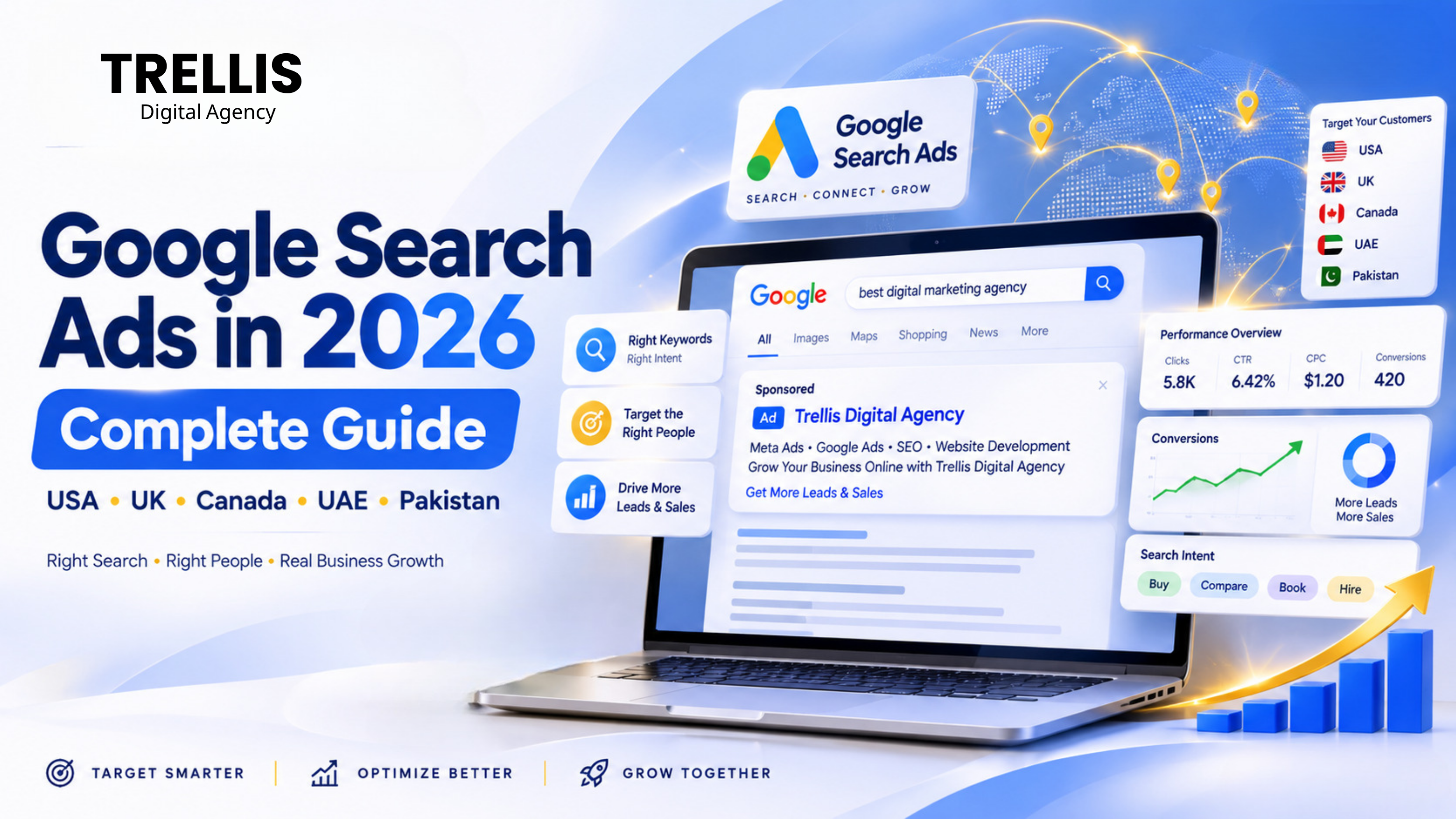
Google Search Ads remain an important way for businesses to connect with people who are actively searching for products and services. Unlike advertising that depends primarily on creating awareness, Search advertising can place a business in front of people at the moment they are expressing an intent through a Google search.
For businesses in the USA, UK, Canada, UAE, Dubai, Pakistan and other international markets, Google Search Ads can support lead generation, e-commerce sales, phone calls, bookings, local enquiries and website traffic. Google describes Search campaigns as a way to reach people actively searching for products or services, with campaign goals including sales, leads and website traffic.
However, successful Google Search advertising is about more than simply selecting keywords and adding a budget. Campaign structure, search intent, location targeting, ad relevance, landing pages, conversion tracking, bidding and ongoing optimisation all influence how effectively an account can use its advertising budget.
This complete guide explains how businesses can approach Google Search Ads in 2026, with practical considerations for the USA, UK, Canada, UAE, Dubai, Pakistan and international markets.
What Are Google Search Ads?
Google Search Ads are paid advertisements that can appear on Google Search when people search for terms related to a business's products or services.
A business selects a Search campaign, establishes its advertising goals, develops relevant keywords and advertisements, chooses targeting and budget settings, and sends interested users to relevant landing pages. Google then uses its advertising auction to determine which eligible ads are shown for particular searches.
Google states that Search campaigns can be used to generate sales, leads or website traffic and are designed to reach people actively searching for relevant products and services.
Search ads are clearly identified as advertisements. Google also explains that businesses can purchase advertising space in eligible areas of Search, but paying for ads does not purchase better organic search rankings.
Why Google Search Ads Matter for Business Growth
One of the major advantages of Search advertising is the connection between a user's search and the advertiser's offering.
Someone searching for “emergency plumber near me,” “SEO agency Dubai,” “dentist in London,” “Shopify development company USA” or “buy natural oil online UAE” is expressing a specific interest. The exact level of commercial intent varies by query, but the search itself provides useful information about what the person wants at that moment.
This makes Search Ads particularly useful for businesses where customers actively research services, compare providers or look for products before making a purchase.
Google also allows advertisers to control important campaign elements such as budgets, keywords, bidding and targeting, while conversion measurement can help businesses evaluate whether advertising is producing meaningful actions.
Google Search Ads in the USA
The USA is a major market for digital advertising, but businesses targeting American customers should not treat the entire country as one identical audience.
A business serving customers in New York may have very different search behaviour, competition and customer expectations from a company serving Texas, California or Florida. A national e-commerce brand may require a completely different structure from a local service company operating in one city.
For USA campaigns, location strategy should reflect the actual service area or shipping availability of the business. A local company should avoid paying for clicks from areas it cannot serve, while an e-commerce business with nationwide delivery may have a broader geographic strategy.
The landing page should also clearly communicate the products or services available to American customers. Pricing, shipping information, contact options, service areas and trust information should match the market being targeted.
For B2B companies, Search campaigns can focus on commercial queries related to specific solutions, while local businesses may concentrate on searches containing locations or service-specific intent.
Google Search Ads in the UK
The UK provides another important market for businesses using Google advertising.
Businesses targeting the UK should consider differences in terminology, spelling, locations and customer expectations. A company should research the actual search language used by its UK audience instead of simply copying keywords from a US campaign.
For example, businesses may need to consider differences such as “optimisation” versus “optimization,” regional location terms and industry-specific language.
Location targeting can be narrowed to the areas a business actually serves. A London-based service provider, for example, may need a different campaign structure from a company serving customers throughout England, Scotland, Wales and Northern Ireland.
A strong UK Search campaign should connect the search query, advertisement and landing page with a consistent message.
Google Search Ads in Canada
Canadian businesses can use Google Search Ads for local services, e-commerce, professional services, B2B solutions and other commercial activities.
Canada's geographic size makes location strategy particularly important. A business operating only in Toronto should not automatically advertise across the entire country.
For businesses serving multiple Canadian regions, separate location analysis can help identify differences in demand and performance.
Businesses should also consider whether their audience requires English, French or both. The advertising message and landing-page experience should correspond with the language and market being targeted.
Google Search Ads in the UAE and Dubai
The UAE is an especially interesting market for businesses targeting customers in Dubai, Abu Dhabi, Sharjah and other Emirates.
Search campaigns in the UAE can support industries such as real estate, healthcare, tourism, hospitality, automotive, e-commerce, professional services, construction, technology and local services.
Dubai campaigns often require particularly precise location and audience planning because businesses can serve customers within specific communities, districts or service areas.
Language is also important. Depending on the business and audience, campaigns may require English, Arabic or a combination of languages. The landing page, advertisement and keyword strategy should reflect the audience being targeted rather than translating campaigns mechanically.
For businesses targeting the UAE from another country, the campaign should also make the business's service availability clear. Customers should quickly understand whether the company operates in the UAE and what locations it serves.
Google Search Ads in Pakistan
Google Search Ads can also support businesses in Pakistan, including local services, e-commerce, education, healthcare, technology, tourism and professional services.
For Pakistani businesses, location targeting can be built around cities such as Islamabad, Lahore, Karachi, Peshawar, Rawalpindi, Faisalabad, Multan and Mingora, depending on the company's actual service area.
A local business should not automatically target the entire country if its services are limited to one city or region.
Search behaviour, language and purchasing behaviour can also differ between markets. Businesses may need to test English, Urdu or industry-specific terminology depending on their audience.
For businesses with limited advertising budgets, accurate location targeting and strong conversion tracking become particularly important because unnecessary traffic can quickly consume available budget.
How Google Search Ads Work
A Search campaign starts with a business objective.
Google's current Search campaign setup includes goals such as Sales, Leads and Website Traffic, while advertisers can also create a campaign without goal guidance. Google requires at least one conversion goal when creating a Search campaign.
The advertiser then develops campaign and ad-group structures, chooses keywords or other Search targeting approaches, creates advertisements and establishes bidding and budget settings.
When someone performs a relevant search, Google evaluates eligible advertisements through its auction system. The advertisement that appears is determined by Google's advertising systems and auction factors rather than simply by the advertiser offering the highest amount.
Search Intent and Google Ads Keywords
Keywords are an important part of Search advertising, but simply collecting large numbers of keywords does not create a strong campaign.
The more important question is what the person searching actually wants.
A search such as “what is SEO” has a different intent from “SEO agency Dubai pricing.” Similarly, “running shoes” may have less obvious purchase intent than “buy men's running shoes online.”
Businesses should therefore organize keywords around meaningful search intent and ensure that advertisements and landing pages answer the needs behind those searches.
Google currently supports broad match, phrase match and exact match keyword options. Google explains that match types control how closely a keyword relates to searches and that broad match can reach searches beyond the exact wording of a keyword.
Broad Match, Phrase Match and Exact Match
Broad match can help advertisers reach a wider range of relevant searches, while phrase and exact match provide different levels of control over matching.
The right approach depends on the account, conversion data, campaign objective and bidding strategy.
Google's current guidance increasingly emphasizes combining AI-powered Search features with Smart Bidding and broad matching when appropriate.
That does not mean advertisers should ignore search quality. Search-term analysis, conversion tracking and negative keyword management remain important parts of controlling traffic quality.
Negative Keywords in Google Search Ads
Negative keywords help prevent advertisements from appearing for searches that are not relevant to the business.
For example, a company selling premium web development services may not want to pay for searches related to free website builders, tutorials or employment opportunities.
Negative keyword management can therefore help reduce irrelevant traffic and improve the relationship between advertising spend and business objectives.
Google's developer documentation also recommends shared negative keyword lists as one approach to improving traffic quality and managing Search campaigns.
Creating High-Converting Google Search Ads
An effective Search advertisement should communicate why the business is relevant to the search.
The headline, description and assets should support the customer's intent instead of simply repeating generic marketing language.
For example, an agency targeting “Google Ads management Dubai” could create messaging around Google Ads management, conversion tracking, campaign optimisation and the UAE market.
The landing page should then provide information that directly supports that promise.
Google currently recommends Responsive Search Ads and provides Ad Strength feedback to help advertisers improve their combinations of headlines and descriptions.
Google's current guidance recommends having at least two Responsive Search Ads with Good or Excellent Ad Strength per ad group.
Google Search Ads and Landing Pages
A Google Ads campaign does not end when someone clicks the advertisement.
The landing page is where the visitor decides whether to continue, contact the business, request a quote, make a purchase or leave.
A strong landing page should match the search intent and advertisement.
If the ad promises “Google Ads Management for Dubai Businesses,” the landing page should immediately explain that service rather than sending visitors to an unrelated homepage.
Page speed, mobile usability, clear calls to action, relevant information, trust signals and an easy conversion process can all contribute to a better user experience.
Google Ads Conversion Tracking
Conversion tracking is one of the most important components of serious Search advertising.
Without reliable conversion data, an advertiser may know that clicks occurred without knowing whether those clicks produced meaningful business outcomes.
Depending on the business, conversions can include purchases, form submissions, phone calls, bookings, quote requests, registrations or other valuable actions.
Google's documentation recommends implementing conversion tracking so advertisers can measure business actions and use those signals for campaign optimisation.
For e-commerce businesses, revenue and purchase value can be particularly important. For lead-generation businesses, lead quality and downstream sales may matter more than simply counting form submissions.
Google Search Ads Budget Strategy
There is no universal Google Ads budget that works for every business.
A suitable budget depends on the market, competition, average customer value, conversion rate, available search volume, margins and business objectives.
A local business with a small service area may require a different budget from an e-commerce company targeting customers throughout the USA.
The key is to connect advertising expenditure with measurable business outcomes.
Instead of asking only how many clicks a budget can purchase, businesses should also ask how many qualified leads, sales or customers those clicks can generate.
Google Search Ads Bidding
Bidding determines how Google participates in the advertising auction for a campaign.
Google provides automated bidding strategies designed around different business objectives. Its current Search guidance discusses Smart Bidding and conversion-based strategies such as Maximize Conversions and target CPA, as well as conversion-value strategies such as Maximize Conversion Value and target ROAS.
The right bidding strategy depends on what the business is trying to achieve and whether sufficient reliable conversion data is available.
Google Search Ads and Smart Bidding
Smart Bidding uses Google's machine learning systems to adjust bids based on auction-time signals.
This can reduce the need to manually determine every individual bid, but automated bidding still depends heavily on the quality of the account's conversion signals.
If the campaign is tracking the wrong actions, automation can optimize toward the wrong outcome.
That is why conversion tracking should be established before relying heavily on automated optimisation.
Google Search Ads in 2026: AI Max and the Changing Search Landscape
Google Search advertising is changing rapidly in 2026.
Google announced that AI Max for Search campaigns is moving out of beta and that the transition from legacy Dynamic Search Ads is being extended, with automatic Dynamic Search Ads upgrades scheduled to begin in February 2027.
Google also announced changes affecting campaign-level language targeting and the migration of certain broad-match and automatically created asset configurations to AI Max during September 2026.
This means advertisers should avoid building a strategy around old Google Ads workflows alone. Campaign managers need to understand Google's evolving AI-powered Search capabilities while continuing to monitor search relevance, conversion quality and business results.
Google has also announced experiments with new Search ad experiences built with Gemini, including advertising formats associated with AI Mode.
Google Search Ads for E-commerce
E-commerce businesses can use Search advertising to reach customers actively researching products.
For an online store, keyword strategy should connect product categories, brands, product types and purchase intent.
A business selling natural oils, for example, could build campaigns around relevant product searches while sending each search to the most relevant product or category page.
Conversion tracking should capture purchases and, where appropriate, purchase value so the business can evaluate revenue rather than simply clicks.
Search Ads can also work alongside other Google advertising products such as Shopping and Performance Max, depending on the overall e-commerce strategy.
Google Search Ads for Local Businesses
Local businesses can use Search Ads to reach people searching for services in particular locations.
A salon in Dubai, clinic in London, digital agency in Lahore or automotive service company in Toronto can structure campaigns around its actual service area and customer intent.
Location-specific landing pages can strengthen this strategy when they provide genuinely useful information for each market.
The most important principle is accuracy. A business should advertise where it can actually serve customers rather than paying for traffic from irrelevant locations.
Google Search Ads for Lead Generation
Lead generation campaigns can be useful for agencies, consultants, clinics, contractors, education providers, real estate companies and other service businesses.
The campaign should focus on searches that indicate meaningful interest in the service.
The landing page can then encourage visitors to submit a form, call the business, request a quotation or schedule a consultation.
But lead quantity alone does not tell the whole story.
If a campaign generates 100 leads but most are irrelevant, the business may receive less value than a campaign generating fewer but better-qualified enquiries.
Google Search Ads vs SEO
Google Search Ads and SEO serve different purposes.
Search Ads provide paid visibility, while SEO focuses on earning organic visibility through search engine optimization.
A business can use both strategies together.
Search advertising can help generate traffic while an SEO strategy develops long-term organic visibility. Search campaign data can also provide insights into customer search behaviour that may inform broader digital marketing decisions.
Google explicitly distinguishes paid Search advertising from organic Search rankings and states that advertisers cannot purchase better organic placement through advertising.
Google Search Ads vs Meta Ads
Google Search Ads and Meta Ads can complement one another because they often address different stages of customer discovery.
Search advertising can connect with people actively searching for a product or service, while Meta advertising can help businesses introduce products, services and offers to audiences across social platforms.
For many businesses, the question is not necessarily which platform should completely replace the other. The more useful question is how each channel fits into the customer's buying journey.
Trellis Digital Agency's existing guide on Facebook Ads vs Google Ads explores this broader comparison in more detail.
How to Improve Google Search Ads Performance
Successful Search campaigns require continuous optimisation rather than a one-time setup.
Businesses should regularly evaluate search terms, conversion data, keyword relevance, advertisement performance, landing-page performance, geographic results and budget allocation.
Google recommends maintaining relevant campaign and ad-group structures and emphasizes the relationship between the search term, advertisement and landing page.
Performance should be evaluated against the business objective.
For a lead-generation company, qualified leads and cost per qualified lead may matter most. For e-commerce, revenue and return on ad spend may be more important. For local businesses, calls, bookings and enquiries may be the primary outcomes.
Common Google Search Ads Mistakes
One common mistake is targeting too broadly without considering where the business can actually serve customers.
Another is choosing keywords based only on search volume rather than commercial intent.
Sending every advertisement to the homepage can also create a disconnect between the user's search and the landing-page experience.
Poor conversion tracking is another major problem because it prevents businesses from accurately understanding which campaigns and searches are producing valuable results.
Businesses can also waste budget by failing to review search terms and exclude irrelevant traffic.
Finally, treating Google Ads as a set-and-forget advertising channel can limit performance. Search campaigns need monitoring, testing and optimisation.
Google Search Ads for International Businesses
International businesses need a different approach from companies serving only one local market.
A business targeting the USA, UK, Canada and UAE should not necessarily duplicate one campaign across all four markets.
Search behaviour, competition, terminology, customer expectations, locations and commercial conditions can differ between countries.
Separate campaigns or carefully structured geographic segments can make it easier to understand performance by market.
Landing pages can also be localized where meaningful differences exist.
For example, a business targeting Dubai may emphasize UAE service coverage, while a UK campaign may require different terminology and location references.
A Complete Google Search Ads Strategy for 2026
A strong Search Ads strategy begins with a clear business objective.
The business should then identify its most valuable customer searches, organize keywords according to intent, create relevant advertisements and connect those ads to useful landing pages.
Conversion tracking should be established so that the business can measure actual outcomes.
From there, bidding and campaign settings can be optimized around reliable data.
As Google's AI-powered Search capabilities continue to evolve, businesses should test new features carefully while maintaining control over their objectives, measurement and customer experience.
Google's own best-practice resources emphasize campaign structure, Search ad quality, AI-powered features and ongoing optimisation as important areas for advertisers.
Google Search Ads for USA, UK, Canada, UAE and Pakistan
Whether you are a local company in Swat, a service business in Lahore, an e-commerce company in Pakistan, a professional service provider in Dubai, a local business in London, a Canadian company or a growing brand in the USA, the fundamentals remain connected: reach relevant searches, communicate a relevant offer, provide a strong landing-page experience and measure the actions that matter to the business.
The exact implementation should change according to the market, customer journey and business model.
How Trellis Digital Agency Can Help With Google Search Ads
Trellis Digital Agency provides digital marketing services for businesses looking to build and grow their online presence.
Our Google Ads services can support Search advertising, campaign strategy, keyword research, conversion tracking, landing-page strategy, campaign optimisation and performance analysis.
We work with businesses in Pakistan, the UAE, UK, USA, Canada and international markets, adapting campaigns to the business's target audience, location and objectives.
For businesses that need leads, sales, bookings, enquiries or e-commerce growth, Google Search Ads can become an important part of a wider digital marketing strategy when campaigns are properly structured, tracked and optimised.
Final Thoughts
Google Search Ads provide businesses with a way to connect with people searching for products and services at moments of active interest.
But successful advertising is not simply about appearing at the top of Google. The real objective is to connect the right search with the right advertisement, the right landing page and the right business outcome.
In 2026, Google's Search advertising environment is becoming increasingly AI-driven, with developments such as AI Max, Smart Bidding and new Search experiences changing how campaigns are managed.
For businesses targeting the USA, UK, Canada, UAE, Dubai, Pakistan and other international markets, a thoughtful combination of search intent, geographic targeting, relevant advertising, accurate conversion tracking and continuous optimisation can provide a strong foundation for paid search growth.