
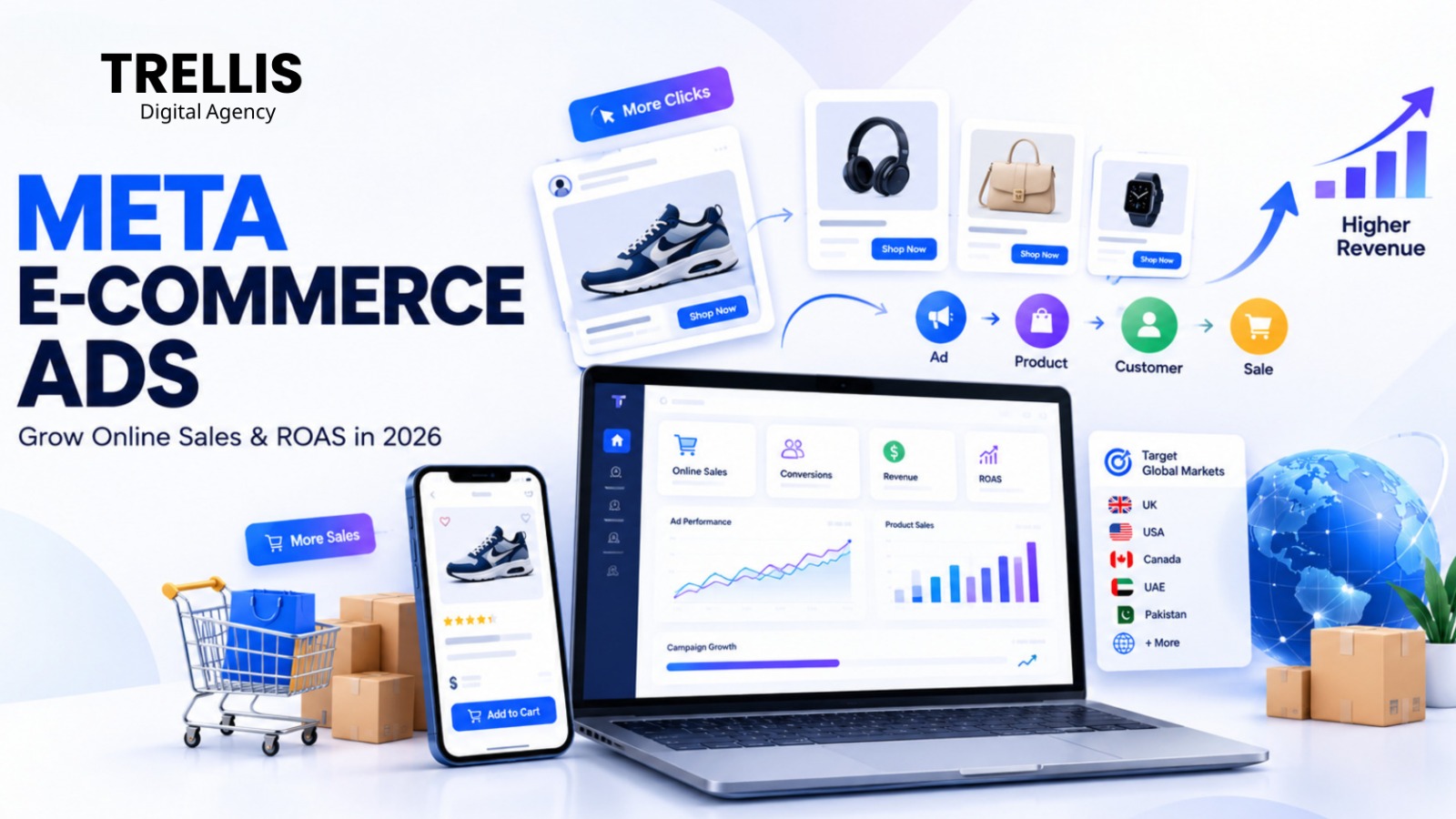
Meta E-commerce Ads have become an important growth channel for online stores that want to reach potential customers, increase product sales, recover abandoned shoppers, and build a scalable customer acquisition system. Through Facebook and Instagram advertising, e-commerce businesses can introduce products to new audiences, reconnect with previous visitors, and encourage customers to complete purchases.
For online stores targeting markets such as the UK, USA, Canada, UAE, Pakistan, Australia, and other international markets, Meta advertising can provide a flexible way to promote products across different stages of the customer journey.
However, successful Meta E-commerce Ads are not simply about creating an advertisement and increasing the budget. Strong performance depends on the relationship between your product, creative strategy, audience, website experience, tracking, offer, campaign structure, and post-purchase data.
This guide explains how businesses can build and optimize a complete Meta E-commerce Ads strategy in 2026, from campaign preparation and product selection to creative testing, retargeting, ROAS optimization, and international expansion.
What Are Meta E-commerce Ads?
Meta E-commerce Ads are paid advertising campaigns created through Meta's advertising ecosystem to promote products and generate online sales. These campaigns can appear across Meta's platforms and placements, including Facebook and Instagram.
Unlike lead generation campaigns, where the primary objective is collecting customer information, e-commerce advertising generally focuses on moving users toward a purchase.
A customer might discover a product through a video advertisement on Instagram, visit the online store, browse several products, add an item to the cart, leave without purchasing, and later see a retargeting advertisement encouraging them to return.
This creates a complete advertising journey from discovery to purchase.
For an e-commerce brand, the goal is therefore not simply to generate impressions or clicks. The goal is to create a system where advertising expenditure contributes to profitable revenue.
Why Meta E-commerce Ads Matter for Online Stores
The major advantage of Meta advertising for e-commerce is the ability to introduce products to people before they actively search for them.
Google Search Ads are often strongest when customers already have purchase intent and are searching for a product or solution. Meta advertising can work differently because products can be introduced through visual content while people are browsing social platforms.
This makes Meta particularly useful for products that benefit from demonstrations, lifestyle presentation, before-and-after storytelling where permitted, product education, unboxing content, customer experiences, and visually attractive creative.
A successful Meta E-commerce Ads campaign can help an online store build awareness, generate website traffic, acquire new customers, recover potential buyers, and increase repeat purchases.
Meta E-commerce Ads Strategy for the UK
The UK e-commerce market provides opportunities for brands selling fashion, beauty, wellness products, home products, accessories, technology, food products, and many other categories.
When targeting the UK, advertisers should consider local customer expectations, pricing in GBP, delivery information, return policies, website trust, product reviews, and clear shipping information.
A UK-focused Meta E-commerce Ads campaign should make the customer journey simple. Someone who sees the advertisement should be able to understand what the product is, why it is useful, how much it costs, and what happens after placing an order.
For competitive UK markets, creative quality and product differentiation can become especially important because customers may encounter advertisements from many competing brands.
Meta E-commerce Ads Strategy for the USA
The United States is one of the most competitive digital advertising markets, but it also offers significant opportunities for e-commerce businesses.
American customers are exposed to a large amount of advertising every day, which means generic product advertisements can struggle to attract attention.
For US campaigns, brands should focus on strong creative concepts, clear product benefits, compelling offers, customer confidence, fast website experiences, and a straightforward checkout process.
A store targeting the USA should also clearly communicate shipping costs, delivery expectations, returns, payment options, and customer support.
Meta E-commerce Ads can be used to test different products and creative concepts before increasing advertising investment in the strongest combinations.
Meta E-commerce Ads Strategy for Canada
Canada can also be an attractive market for international e-commerce businesses.
When targeting Canada, businesses should consider geographic distribution, shipping costs, delivery expectations, currency presentation, product availability, and the differences between customer segments.
A campaign designed for Canada should not simply copy an advertisement created for another country without considering the customer experience.
If a product has different shipping costs or delivery times in Canada, the advertisement and landing page experience should make the information easy to understand.
Trust and transparency can help reduce hesitation during the purchase process.
Meta E-commerce Ads for UAE and Gulf Markets
The UAE is an important market for businesses targeting customers in Dubai, Abu Dhabi, Sharjah, and other locations.
E-commerce brands targeting the UAE should consider AED pricing, delivery speed, payment preferences, mobile shopping behavior, Arabic and English communication where appropriate, and local customer expectations.
For premium products, visual presentation can be particularly important. High-quality product photography, elegant video content, professional branding, and clear product benefits can help establish credibility.
For local e-commerce businesses, Meta E-commerce Ads can also be combined with retargeting and WhatsApp-based customer communication where appropriate.
Meta E-commerce Ads for Pakistan
Pakistan offers opportunities for e-commerce businesses across fashion, beauty, personal care, electronics, accessories, home products, food, and other categories.
For Pakistani audiences, advertisers should consider local payment preferences, Cash on Delivery where offered, delivery coverage, mobile-first website experiences, and customer trust.
COD can create additional operational challenges because an order does not necessarily mean a completed sale. Businesses should therefore monitor not only purchases reported by the advertising platform but also confirmed, delivered, returned, and cancelled orders.
This distinction is important when calculating the actual profitability of Meta E-commerce Ads.
The Foundation of a Successful Meta E-commerce Ads Campaign
Before launching advertising, an online store needs a strong foundation.
Your website should load quickly, work properly on mobile devices, display products clearly, provide accurate pricing, explain shipping and returns, and offer a simple checkout experience.
Product pages should contain high-quality images, useful descriptions, important specifications, customer reviews where available, and clear purchasing options.
The advertising campaign cannot completely compensate for a poor website.
If an advertisement generates thousands of visitors but the product page is confusing or checkout is difficult, increasing the advertising budget may simply increase wasted expenditure.
Meta Pixel and Conversions API for E-commerce
Tracking is one of the most important components of Meta E-commerce Ads.
The Meta Pixel can help businesses measure actions taken on their website, while Conversions API can provide an additional server-side connection for sending relevant conversion events.
For an e-commerce website, important events can include product views, searches, add-to-cart actions, checkout initiation, purchases, and other relevant customer actions.
Accurate tracking helps advertisers understand which campaigns and creative combinations are contributing to conversions.
Before scaling advertising, businesses should verify that purchase tracking is functioning correctly and that important events are being recorded consistently.
Product Catalog and Dynamic Product Advertising
A properly structured product catalog can become an important part of an e-commerce advertising strategy.
A catalog allows products, images, prices, descriptions, and other information to be connected with Meta advertising systems.
This can support product-focused advertising and retargeting experiences where shoppers are shown products relevant to their previous interactions.
For stores with many products, catalog-based advertising can be particularly useful because manually creating separate advertisements for every product is inefficient.
A well-maintained catalog should contain accurate product information and regularly updated availability.
Choosing Products for Meta Advertising
Not every product should necessarily receive the same advertising budget.
Some products naturally perform better on social media because they are visually appealing, solve an obvious problem, have strong margins, or can be demonstrated effectively through video.
Before launching a large campaign, businesses should identify products with attractive economics and strong customer appeal.
The product's selling price is only one part of the equation.
Businesses should also consider product cost, shipping, payment fees, returns, discounts, taxes where applicable, and customer acquisition costs.
A product that generates high revenue but has very low margin may not support aggressive advertising.
Creative Strategy for Meta E-commerce Ads
Creative is one of the most important elements of Meta E-commerce Ads.
Users scroll quickly through social platforms, so an advertisement needs to communicate its value quickly.
Product demonstrations can be effective because they show customers what the product actually does.
Short-form videos can demonstrate the product from multiple angles, explain its use, show packaging, answer common questions, or demonstrate a real customer scenario.
User-generated-content-style creative can also provide a more natural presentation than traditional advertisements, provided it is authentic and complies with applicable advertising policies.
Static product advertisements can still be valuable, particularly when the product image, offer, headline, and visual hierarchy are strong.
The objective should not be to create one perfect advertisement and leave it unchanged forever. E-commerce advertisers should continuously test creative concepts and identify which approaches generate profitable results.
Product Demonstration Ads
A product demonstration advertisement can show the product being used in a realistic environment.
For example, a skincare brand might demonstrate product application, while a home product brand could show the product solving a practical household problem.
The demonstration should focus on the customer experience rather than simply displaying the product.
A strong creative should help answer the customer's question:
Why should I care about this product?
UGC-Style E-commerce Advertising
UGC-style advertising presents products in a more personal and conversational format.
Instead of creating an advertisement that looks like a traditional commercial, the creative can feel more like a customer recommendation, product review, demonstration, or personal experience.
This style can work well for products where trust and demonstration are important.
However, businesses should avoid fake testimonials, misleading claims, fabricated experiences, or unsupported promises.
Authenticity matters.
Retargeting With Meta E-commerce Ads
Not every customer purchases during their first visit.
Someone may visit a product page, add the product to their cart, compare alternatives, or simply become distracted.
Retargeting allows businesses to reconnect with people who have already interacted with the brand.
A customer who viewed a particular product could receive a relevant follow-up advertisement.
Someone who added an item to their cart could receive a reminder.
Previous customers could receive advertisements for complementary products or new collections.
Retargeting works best when the message reflects the customer's previous interaction rather than showing exactly the same advertisement to everyone.
Meta E-commerce Ads and Abandoned Cart Recovery
Abandoned carts represent potential revenue that was not completed.
Retargeting campaigns can remind shoppers about products they previously considered.
However, businesses should first investigate why customers are abandoning checkout.
Unexpected shipping costs, complicated checkout processes, limited payment methods, slow websites, lack of trust signals, unclear return policies, or delivery concerns can all contribute to abandonment.
Advertising should therefore be part of a broader conversion optimization strategy rather than the only solution.
How to Measure Meta E-commerce Ads Performance
One of the most important mistakes in advertising is focusing on a single metric.
Clicks can look impressive without producing sales.
A low cost per click does not necessarily mean a campaign is profitable.
For e-commerce, businesses should evaluate metrics such as purchases, revenue, conversion rate, average order value, cost per purchase, advertising spend, and return on advertising spend.
Understanding ROAS
ROAS means Return on Advertising Spend.
If a business spends $1,000 on advertising and generates $4,000 in tracked revenue, the ROAS is 4.0.
However, ROAS should not automatically be treated as profit.
A business still needs to account for product costs, shipping, payment processing, discounts, returns, taxes, staff costs, and other expenses.
This is why profitable Meta E-commerce Ads require an understanding of the entire business economics.
How to Improve Meta E-commerce Ads ROAS
Improving ROAS is not always about reducing advertising costs.
A campaign can become more profitable by increasing conversion rates, increasing average order value, improving creative performance, reducing wasted spend, improving product margins, and increasing repeat purchases.
For example, if an online store increases its average order value through relevant product bundles, the same customer acquisition cost may become more profitable.
Similarly, improving the product page can increase the percentage of advertising visitors who purchase.
This means Meta E-commerce Ads optimization should include both advertising and website conversion optimization.
Testing Meta E-commerce Ads
Testing should be structured rather than random.
Businesses can test different creative concepts, product presentations, hooks, offers, audiences, landing pages, and retargeting messages.
The purpose of testing is to learn what combination produces the strongest business outcome.
Changing too many variables simultaneously can make it difficult to understand what caused a performance change.
A better approach is to establish a clear hypothesis and compare meaningful variations.
For example, an e-commerce brand might test a product demonstration against a lifestyle advertisement to determine which creative generates stronger purchase performance.
Scaling Meta E-commerce Ads
Once a campaign demonstrates consistent results, businesses may consider increasing investment.
Scaling should be approached carefully.
Increasing budgets too aggressively can change delivery patterns and performance.
A strong campaign should have enough evidence that the results are not simply caused by a small amount of random data.
Businesses should also consider whether the product has sufficient inventory, whether fulfillment can handle additional orders, and whether customer support can manage increased demand.
Advertising growth without operational preparation can create customer service and fulfillment problems.
International Scaling With Meta E-commerce Ads
A business that succeeds in one market may eventually want to expand internationally.
The UK, USA, Canada, UAE, Australia, and other markets can provide potential opportunities, but international expansion requires more than copying the same campaign.
Different countries have different customer expectations, competition levels, currencies, shipping costs, purchasing behavior, regulations, and market conditions.
A successful international strategy should consider the complete customer experience in each target market.
The advertisement, website, currency, delivery information, payment options, product availability, customer support, and return policy should work together.
Meta E-commerce Ads and Seasonal Campaigns
E-commerce advertising can become particularly important during seasonal shopping periods.
Businesses may create campaigns around holidays, special promotions, product launches, seasonal collections, and major shopping events.
However, seasonal advertising should be planned before demand reaches its peak.
Creative production, product inventory, landing pages, tracking, budgets, and promotional offers should be prepared in advance.
Businesses should also avoid assuming that increasing the advertising budget alone will guarantee higher sales during competitive periods.
Common Meta E-commerce Ads Mistakes
One of the biggest mistakes is launching advertising without properly configured tracking.
Another common problem is sending paid traffic to a slow or poorly designed website.
Some businesses also use the same creative for months without refreshing their advertising content.
Others focus entirely on cheap clicks rather than purchases and revenue.
A further problem is scaling a campaign before understanding its true economics.
Successful e-commerce advertising requires a complete view of the customer journey.
Meta E-commerce Ads for Small Businesses
Small businesses do not necessarily need enormous advertising budgets to begin testing Meta advertising.
The important factor is creating a controlled testing process.
A small business can begin by selecting a suitable product, preparing strong creative, ensuring the website and tracking work correctly, and collecting enough data to make informed decisions.
As the business understands its customer acquisition economics, it can gradually develop a more sophisticated advertising strategy.
Meta E-commerce Ads for Growing Brands
Growing e-commerce businesses often need a more structured approach.
At this stage, advertising may involve multiple products, creative concepts, audiences, retargeting segments, countries, and campaigns.
Businesses should develop clear reporting systems and understand how advertising performance connects with actual sales.
CRM data, customer purchase history, product margins, and repeat purchase behavior can provide valuable information when evaluating advertising performance.
The Future of Meta E-commerce Advertising
Meta's advertising ecosystem continues to become more automated, making creative quality, accurate data, strong offers, and high-quality customer experiences increasingly important.
Artificial intelligence and automated optimization can help platforms identify people who are more likely to take desired actions, but businesses still need to provide strong inputs.
The future of successful Meta E-commerce Ads is therefore not simply about targeting more narrowly.
It is increasingly about providing the advertising system with quality creative, reliable conversion signals, strong products, and enough data to optimize toward valuable customers.
Why Businesses Need a Complete E-commerce Marketing Strategy
Meta E-commerce Ads can be powerful, but they should not operate in isolation.
A successful online store can combine Meta Ads with SEO, Google Ads, email marketing, content marketing, social media, retargeting, conversion rate optimization, and customer retention.
Meta can introduce a customer to a brand.
Google can capture customers actively searching for products.
SEO can build long-term organic visibility.
Email marketing can encourage repeat purchases.
A strong website can convert traffic into customers.
When these channels work together, businesses can build a more resilient digital marketing system.
Meta E-commerce Ads With Trellis Digital Agency
At Trellis Digital Agency, we help businesses develop digital marketing strategies designed around growth.
Our approach to Meta E-commerce Ads focuses on understanding the product, target market, customer journey, advertising creative, website experience, tracking, and business economics.
We can help e-commerce businesses develop campaigns for markets including Pakistan, the UK, USA, Canada, UAE, and other international markets.
Our broader digital marketing services include Meta Ads, Google Ads, SEO, website development, e-commerce solutions, social media management, branding, graphic design, and digital marketing strategy.
The objective is not simply to generate advertising activity. The objective is to build a digital system that helps businesses attract customers and grow.
Final Thoughts on Meta E-commerce Ads
Meta E-commerce Ads can provide online stores with a powerful way to introduce products, reach new customers, retarget interested shoppers, and generate sales.
But successful advertising requires more than launching a campaign.
The product needs to be competitive. The creative needs to capture attention. The website needs to provide a strong customer experience. Tracking needs to provide reliable data. The offer needs to make sense. The business needs to understand its margins and customer acquisition economics.
When these components work together, Meta advertising can become an important part of an e-commerce growth strategy.
For businesses targeting the UK, USA, Canada, UAE, Pakistan, and other international markets, the opportunity is not simply to run advertisements. The opportunity is to build a complete customer acquisition system that connects advertising with website conversion, sales, and long-term customer value.
Grow Your E-commerce Business With Trellis Digital Agency
If you are planning to launch Meta E-commerce Ads, improve an existing campaign, increase online sales, or expand your store into international markets, Trellis Digital Agency can help you build a strategy around your business goals.
Trellis Digital Agency — Digital Marketing, Meta Ads, Google Ads, SEO, Website Development, E-commerce Solutions, and Business Growth.
Based in Mingora, Swat, Khyber Pakhtunkhwa, Pakistan — working with businesses locally and internationally.